
Homeschooling in Puerto Rico: Your Complete 2025 Guide
Homeschooling in Puerto Rico has become an increasingly popular choice for families seeking educational flexibility and personalized learning experiences. As an unincorporated territory of the United States, Puerto Rico offers unique opportunities for home education while maintaining its own distinct educational landscape and cultural identity.
Whether you’re a Puerto Rican family considering homeschooling for the first time, a mainland family relocating to the island, or simply exploring your educational options, understanding the legal requirements and practical considerations of homeschooling in Puerto Rico is essential. This comprehensive guide covers everything you need to know about homeschool education in Puerto Rico for 2025, from legal compliance to curriculum selection and community support.
Can I Homeschool My Kids in Puerto Rico?
Yes, you absolutely can homeschool your children in Puerto Rico. Parents in Puerto Rico have a fundamental right to choose homeschooling as a means to fulfill their duty to provide their child with an adequate education. This right is protected under Puerto Rico law (L.P.R.A. 18 section 2322 and L.P.R.A. 8 section 444(w)).
In Puerto Rico, homeschooling is legally recognized and commonly referred to by its Spanish phrase “educación en el hogar.” The law explicitly uses the English term “homeschooling,” making it clear that this educational option is both legitimate and protected under Puerto Rican law.
What makes Puerto Rico particularly attractive for homeschooling families is its minimal regulatory requirements. Unlike some mainland states that impose strict oversight and reporting requirements, Puerto Rico treats homeschools as “non-governmental entities” or “non-governmental schools,” which means they are largely unregulated. In a homeschool setting, parents serve as both the governing entity and the principal of the school.
Understanding “Adequate Education” in Puerto Rico
Puerto Rico law requires parents to provide an “adequate” education, but notably, the law does not define what constitutes adequate education. This intentional ambiguity gives parents considerable flexibility in designing their homeschool programs. Generally, an adequate education should be understood as one that will adequately prepare your child for adult life and responsibility, taking into account your child’s individual characteristics, abilities, and learning needs.
This flexible definition means you can tailor your homeschool curriculum to:
- Match your child’s unique learning style and pace
- Incorporate cultural and linguistic elements important to your family
- Focus on subjects and skills that align with your child’s interests and future goals
- Address any special educational needs or learning differences
- Balance academic rigor with real-world experiences and practical life skills
Is School Required in Puerto Rico?
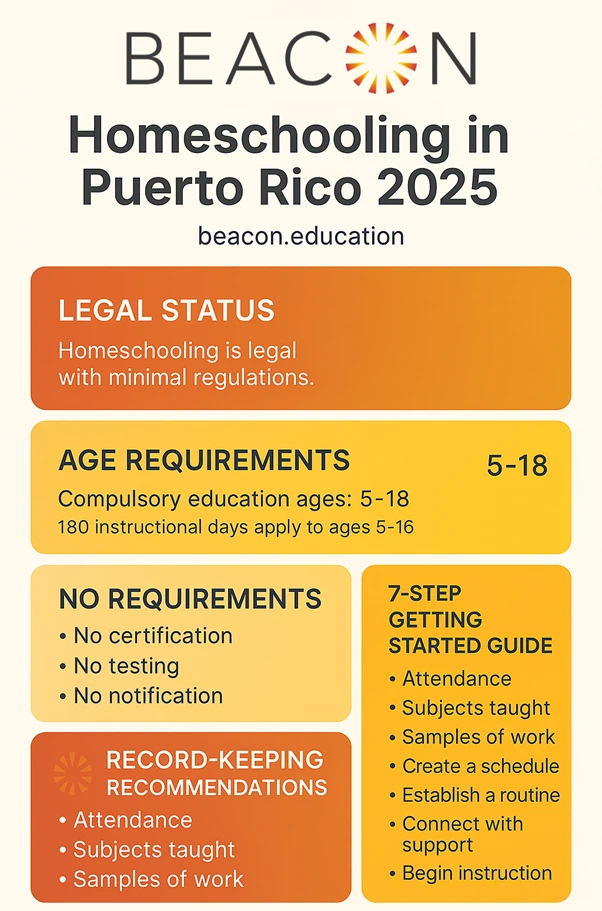
Yes, education is compulsory in Puerto Rico, but this requirement can be fulfilled through homeschooling. Puerto Rico law mandates that children between the ages of 5 and 18 must either attend school or comply with homeschool laws. This means that once your child turns 5 years old, you must provide education – whether through public school, private school, or homeschooling – until they reach 18 years of age.
Compulsory School Age Requirements
Understanding the age requirements for homeschooling in Puerto Rico is crucial for compliance:
Ages 5-16: During this period, parents must provide the same number of instructional days as public schools. Puerto Rico public schools typically operate on a 180-day school year, and homeschooling families should plan to match this requirement. This ensures that homeschooled children receive a comparable amount of instructional time as their traditionally schooled peers.
Ages 16-18: After a child turns 16, a specific number of instructional days is no longer required by law. However, many families choose to continue following a structured schedule to ensure their student completes a comprehensive secondary education and is well-prepared for college, career, or other post-graduation paths.
Age 18 and Beyond: Once a student reaches 18, they are no longer subject to compulsory education laws. However, families may want to continue homeschooling until high school graduation and diploma issuance to ensure proper documentation for college applications, military enlistment, or employment.
Importance of Maintaining Records Beyond Compulsory Age
Even if your child is beyond the compulsory school attendance age, continuing to follow homeschool requirements and maintaining proper records is highly advisable. These records may be requested in several important situations:
- Obtaining a driver’s license if your child is a minor
- Enlisting in the military
- Applying to colleges and universities
- Demonstrating eligibility for Social Security benefits
- Employment applications that require proof of high school completion
Legal Requirements for Homeschooling in Puerto Rico
One of the most appealing aspects of homeschooling in Puerto Rico is the minimal legal requirements. Puerto Rico’s homeschool-friendly laws make it one of the easiest places in the United States and its territories to begin homeschooling.
No Registration or Approval Required
Homeschools in Puerto Rico are not required to seek approval or recognition from any government agency, nor are parents required to provide formal notice of their homeschool program. This means you don’t need to:
- Register with the Department of Education
- Submit a notice of intent to homeschool
- File annual progress reports
- Have your curriculum approved by educational authorities
- Allow home visits or inspections
Withdrawing from Public School
While formal notification is not legally required, if you’re withdrawing your child from public school to begin homeschooling, it is highly advisable to communicate this decision in writing to the school principal. This written notification:
- Creates a clear record of your intent to homeschool
- Prevents potential truancy issues or misunderstandings
- Ensures your child is properly removed from school enrollment records
- Provides documentation if questions arise in the future
Your withdrawal letter should be brief and professional, simply stating that you are withdrawing your child to homeschool under Puerto Rico law. You are not required to provide detailed curriculum plans or justifications for your decision.
Teacher Certification and Qualifications
Homeschool teachers in Puerto Rico are not required to be certified, licensed, or hold any specific degree to teach at home. This means:
- You don’t need a teaching degree or education background
- You don’t need to obtain teaching certification or licenses
- You can teach regardless of your educational background
- Your passion, dedication, and knowledge of your child are your primary qualifications
Testing and Assessment Requirements
Puerto Rico does not require homeschool students to take standardized tests. Parents are free to:
- Choose their own assessment methods
- Utilize standardized tests voluntarily if they wish
- Conduct portfolio assessments
- Use narrative evaluations and progress reports
- Implement project-based assessments
Many families choose to conduct standardized testing voluntarily for their own records or to prepare for college entrance exams. This decision is entirely at the parent’s discretion.
Record-Keeping Recommendations
While Puerto Rico does not require homeschool parents to keep records or provide progress reports to school officials, maintaining comprehensive records is strongly recommended by the Home School Legal Defense Association (HSLDA) and experienced homeschool families. Good record-keeping protects your family in case laws change and provides essential documentation for your child’s future.
Recommended records to maintain:
- Attendance records: Track the days and hours of instruction throughout the school year
- Curriculum documentation: Maintain titles of textbooks, workbooks, and online resources used
- Student work samples: Keep representative samples of your student’s work across subjects
- School correspondence: Save any correspondence with school officials, including withdrawal letters
- Portfolio and assessments: Compile portfolios and results from any tests or evaluations you administer
- High school transcripts: Maintain detailed course descriptions, grades, and credit hours for grades 9-12
- Extracurricular activities: Document participation in sports, clubs, volunteer work, and other activities

Diplomas and Graduation Requirements
Understanding the rules around diplomas and transcripts is essential for homeschooling families, especially those with high school students.
Important Licensing Requirement
Puerto Rico law states that a “primary or secondary academic” school that “declares, promises, announces, or expresses the intention of granting certificates, diplomas, degrees, or licenses” must be licensed. This means that if you plan to present an official certificate or diploma upon graduation, your homeschool technically must be licensed.
However, this requirement is somewhat ambiguous in practice, and many homeschool families navigate it in different ways. According to HSLDA, a parent-issued diploma and transcript should be sufficient to demonstrate that a child has completed a secondary education.
Transcripts vs. Diplomas
Importantly, homeschools are explicitly authorized to issue transcripts showing that the student has completed relevant academic courses and studies. Transcripts are often more valuable than diplomas for college admissions and other purposes, as they provide detailed information about:
- Courses taken and subjects studied
- Grades earned in each course
- Credit hours completed
- GPA and class rank (if applicable)
- Graduation date and parent signature
Most colleges, employers, and other institutions readily accept homeschool transcripts created by parents. If you have concerns about diploma and transcript requirements for your specific situation, consider consulting with HSLDA or a local homeschool support organization.
Curriculum and Educational Approach
The freedom to choose your own curriculum is one of the greatest advantages of homeschooling in Puerto Rico. Since there are minimal regulations, families can select educational approaches and materials that best suit their children’s needs, learning styles, and family values.
Subject Recommendations
While not legally required, HSLDA recommends that homeschool families teach the same subjects for the same number of days as local public schools. This recommendation helps ensure your child receives a well-rounded education comparable to traditionally schooled students.
Core subjects typically include:
- Language Arts: Reading, writing, grammar, literature (in English and/or Spanish)
- Mathematics: From basic arithmetic through algebra, geometry, and beyond
- Science: Biology, chemistry, physics, earth science, environmental science
- Social Studies: History (Puerto Rican, U.S., and world), geography, civics, economics
- Physical Education: Exercise, sports, health, and wellness
- Arts: Visual arts, music, drama, or other creative pursuits
Bilingual Education Opportunities
Puerto Rico’s unique linguistic landscape offers exceptional opportunities for bilingual education. Many homeschooling families take advantage of this by:
- Teaching in both Spanish and English
- Incorporating Puerto Rican history and culture into lessons
- Using bilingual curriculum materials
- Participating in cultural activities and community events
- Reading literature in both languages
Choosing a Curriculum
Homeschooling families in Puerto Rico can choose from a wide variety of curriculum options:
Traditional textbook-based curricula: Structured programs that follow a traditional school-like approach
Online and digital learning programs: Interactive computer-based curricula and virtual schools
Classical education: Focused on the trivium (grammar, logic, rhetoric) and great books
Charlotte Mason method: Emphasizing living books, nature study, and narration
Montessori approach: Child-led learning with hands-on materials
Unschooling: Student-directed learning based on natural interests and experiences
Unit studies: Thematic learning integrating multiple subjects around central topics
Eclectic approach: Mixing and matching various methods and materials
Accredited Homeschool Programs for Puerto Rico
Many Puerto Rican families choose to work with US-based accredited homeschool programs. These programs provide structure, support, and official documentation while still allowing families to homeschool at their own pace and in their own way.
Benefits of Accredited Programs
Working with an accredited program offers several advantages:
- Official transcripts and diplomas: Recognized by colleges and employers
- Record-keeping support: Professional maintenance of academic records
- Curriculum guidance: Expert advice on course selection and educational planning
- Flexible learning options: Programs designed to work with limited internet access
- Academic support: Access to teachers and advisors
- Standardized testing: Optional assessment and college prep resources
- Peace of mind: Confidence that your homeschool meets educational standards
These programs are particularly valuable for families who want the freedom of homeschooling combined with the structure and credibility of an established educational institution.
Access to Public School Activities and Resources
One question many homeschooling families have is whether their children can participate in public school activities while being homeschooled.
Current Status of Public School Access
Currently, there is no law in Puerto Rico stating that homeschool students have the right to participate in public school activities and classes. Unlike some U.S. states that have enacted “equal access” laws, Puerto Rico leaves this decision to the discretion of individual schools and school district authorities.
This means that access to public school resources such as:
- Sports teams and athletic programs
- Extracurricular clubs and activities
- Arts programs and performances
- Science labs and specialized facilities
- Part-time class enrollment
…is determined on a case-by-case basis by local school administrators. If you have interest in pursuing public school access for specific activities, it’s best to contact your local school administration directly to inquire about their policies.

Homeschool Support and Community in Puerto Rico
While homeschooling numbers in Puerto Rico are relatively modest compared to the mainland United States – with an estimated 300 to 400 families actively homeschooling as of 2019 – the community has been growing steadily, particularly following the COVID-19 pandemic. This growth has led to increased support networks and resources for homeschooling families.
Local Support Organizations
Several organizations provide support specifically for Puerto Rican homeschool families:
Local co-ops and support groups: Many communities have informal networks of homeschooling families who meet regularly for field trips, group classes, and social activities.
Online communities: Social media groups connect Puerto Rican homeschool families for advice, encouragement, and resource sharing.
National Support Resources
Home School Legal Defense Association (HSLDA): Provides legal support, advocacy, and guidance for homeschool families in Puerto Rico. HSLDA members can access attorney consultation and legal representation if needed.
As homeschooling continues to grow in Puerto Rico, families can expect to see even more support networks and resources become available.
Challenges and Considerations for Puerto Rican Homeschoolers
While homeschooling in Puerto Rico offers many freedoms, families should be aware of some unique challenges specific to the island.
Internet Access and Technology
One significant challenge facing Puerto Rican families is limited internet access and technology resources. According to recent statistics:
- Approximately 25 percent of Puerto Rico’s children have no access to the internet
- 56 percent do not own a computer
- WiFi signals can be insufficient even within 20 miles of San Juan
These technology gaps can make online curriculum options challenging for some families. However, many curriculum providers, including Bridgeway Academy, offer programs specifically designed to work with limited internet access, featuring downloadable materials and offline learning options.
Economic Considerations
Puerto Rico faces significant economic challenges, with approximately 71 percent of children under 18 either on the verge of or living in poverty, and 38 percent living in extreme poverty. These economic realities can make homeschooling more difficult, as families must consider:
- Curriculum and materials costs
- Loss of income if a parent needs to stay home
- Technology and internet expenses
- Field trip and activity costs
Despite these challenges, many families find creative solutions through free online resources, library programs, used curriculum exchanges, and co-op arrangements that share costs.
Getting Started with Homeschooling in Puerto Rico
Ready to begin your homeschool journey? Here’s a step-by-step guide to help you get started.
Step 1: Research and Decision-Making
- Research different homeschooling methods and philosophies
- Talk to other homeschool families in your area
- Assess your family’s needs, goals, and learning styles
- Consider your budget and available resources
Step 2: Withdraw from School (If Applicable)
- Write a formal withdrawal letter to your child’s school principal
- State clearly that you are withdrawing your child to homeschool
- Keep a copy of the letter for your records
- Request copies of your child’s academic records
Step 3: Choose Your Curriculum and Approach
- Select curriculum materials for each subject
- Consider enrolling with an accredited program if desired
- Plan your school year calendar
- Create a daily or weekly schedule
Step 4: Set Up Your Learning Environment
- Designate a learning space in your home
- Gather necessary supplies and materials
- Organize books, resources, and educational materials
- Set up technology and internet access if available
Step 5: Establish Record-Keeping Systems
- Create an attendance tracking system
- Set up a portfolio or filing system for student work
- Document curriculum and resources used
- Maintain a record of books read and projects completed
Step 6: Connect with the Homeschool Community
- Join local homeschool support groups
- Connect with online Puerto Rican homeschool communities
- Attend homeschool meetups and field trips
- Consider joining HSLDA for legal support
Step 7: Begin Teaching and Stay Flexible
- Start your homeschool year with realistic expectations
- Be prepared to adjust your approach as needed
- Focus on your child’s progress rather than comparison to others
- Remember that learning happens everywhere, not just at a desk
- Celebrate successes and learn from challenges
Beacon Education: Your Partner in Homeschooling Success
At Beacon Education, we understand the unique needs and challenges of homeschooling families in Puerto Rico. Whether you’re just beginning your homeschool journey or looking to enhance your existing program, we offer comprehensive support, quality curriculum options, and expert guidance tailored to Puerto Rican families.
Our programs are designed to work within Puerto Rico’s flexible homeschool laws while providing the structure and accountability that families value. We offer:
- Accredited curriculum options for all grade levels
- Bilingual education support in English and Spanish
- Flexible programs that accommodate varying internet access
- Official transcripts and diplomas
- Expert educational advisors who understand Puerto Rican homeschool law
- Comprehensive record-keeping services
- College preparation and guidance for high school students
A Journey Not a Destination
Homeschooling in Puerto Rico offers families the freedom to create personalized educational experiences that honor their children’s unique learning needs, cultural heritage, and family values. With minimal legal requirements, flexible approaches, and a growing support community, Puerto Rico provides an ideal environment for home education.
Whether you’re a seasoned homeschooler or just beginning to explore this educational option, Puerto Rico’s homeschool-friendly laws make it easier than ever to take charge of your child’s education. By understanding the legal requirements, choosing appropriate curriculum, maintaining good records, and connecting with support networks, you can create a successful homeschool experience that prepares your children for bright futures.
Remember, homeschooling is a journey, not a destination. Give yourself grace as you learn, remain flexible in your approach, and celebrate the special opportunity you have to be intimately involved in your child’s education.